Before the Finish Line: Where the Marathon Came From
Where the marathon came from: trace how an ancient Greek story inspired a modern Olympic race, and see why its rules and distance developed separately.
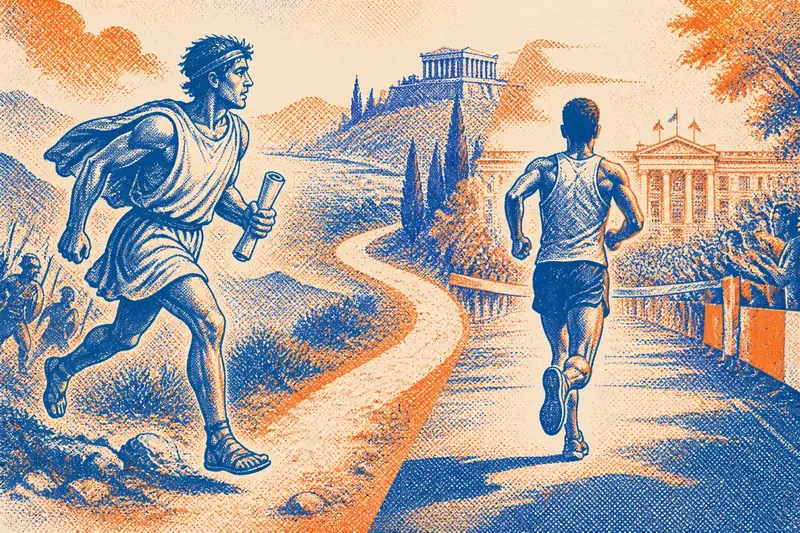
At the start of a marathon, runners may pass a sign pointing toward Marathon, Greece, or hear the ancient story repeated over a loudspeaker. Where the marathon came from is a tale of two histories: a messenger tradition associated with the Battle of Marathon and a modern sporting event created many centuries later.
The distinction is useful because the famous story lends the race its name and drama, while organized sport supplied its course, rules, and place on the calendar.
The messenger story offered a memorable name
The familiar account tells of a messenger who ran from the area of Marathon to Athens to announce a Greek victory, then died. It is a vivid image of a runner carrying urgent news to a waiting community.
Ancient accounts do not give a single, consistent record of this exact journey as it is told today. Stories about the battle, messengers, and their routes differ, and later retellings helped shape the version now associated with the race. The story is best understood as cultural memory, not as a verified race report with a known route and distance.
That does not make the story irrelevant. It helps explain why the name came to suggest endurance and public duty, even though those ideas do not establish an ancient sporting event called the marathon.
Organizers turned the story into an Olympic race
The modern marathon emerged with the revival of the Olympic Games in the late nineteenth century. Organizers of the first modern Olympics, held in Athens in 1896, included a long-distance race inspired by the messenger tradition. The course ran from the Marathon area toward Athens, making the setting part of the event’s appeal.
This was a new sporting contest, not the reopening of an ancient race with preserved rules. Its organizers used a story connected with Greek history to give a new event a powerful setting and purpose. The modern marathon’s turning point was that deliberate act of adaptation: an old tale became the inspiration for an organized competition.
The route also made the contest easy to follow. A runner set out from one place and aimed to arrive at another, with the city waiting at the finish. That simple shape gave spectators a clear story alongside the athletic contest.
The standard distance came through later sporting decisions
The earliest modern marathon races did not all cover the same distance. Courses were arranged for particular events and venues, so the length varied. The race was recognized by its long-distance character and its connection to the Marathon story, not by a universal measurement.
As organized competition developed, a standard distance became useful for comparing races and setting consistent rules. That distance was a sporting convention, not a measurement preserved from the legendary messenger’s journey. Treating it as ancient would confuse the modern event’s development with the much less certain details of the old story.
For anyone preparing a short presentation, a simple timeline keeps the distinction clear: place the messenger tradition in ancient Greece, the Olympic race in 1896, and the later standardization in the development of modern sport. This gives each part its own place without suggesting an unbroken race tradition.
Public races gave the event a life beyond the Olympics
As the marathon spread to other sporting programs and cities, it became more than a race evoking one Greek route. Local organizers could stage an event on their own streets, and runners and spectators could make it part of community life. The name remained, but the setting and purposes broadened.
That public form depends on more than the runners. Course planners, officials, volunteers, and spectators help turn a long run into an organized civic event. A city might use a race to bring people together, while an individual runner might see it as a personal challenge. These meanings grew alongside the sporting institution rather than coming directly from the ancient account.
Imagine a school history club making a display with two cards. The first describes the messenger tradition and notes that its details are not a confirmed route; the second explains that Olympic organizers created a modern race inspired by it. Visitors could then see both the connection and the break without mistaking inspiration for uninterrupted history.
What readers ask about where the marathon came from?
Did an ancient runner complete the modern marathon?
The messenger story is associated with ancient Greece, but it does not document a race with the modern event’s course or distance. The organized marathon was created much later.
Why is the race called a marathon?
The name comes from Marathon, the place linked to the battle and messenger tradition. Modern organizers drew on that association when they created the long-distance race.
Was the distance fixed from the first modern race?
No. Early modern courses varied according to their venues and occasions. A standard distance developed later as sporting rules became more consistent.
Is today’s marathon a direct continuation of an ancient Greek race?
The familiar story does not establish a continuous ancient sporting institution. The modern marathon is a later event inspired by ancient memory.
Tell the history without blending its two timelines
When explaining where the marathon came from, keep the ancient messenger tradition distinct from the modern race that drew inspiration from it. The first supplied a compelling story; Olympic organizers and later sporting bodies shaped the event’s routes and standards.
That distinction makes room for both the story’s cultural force and the modern organizers’ achievement. A tradition can honor an evocative past while being honest about the choices that made it a sport.